|
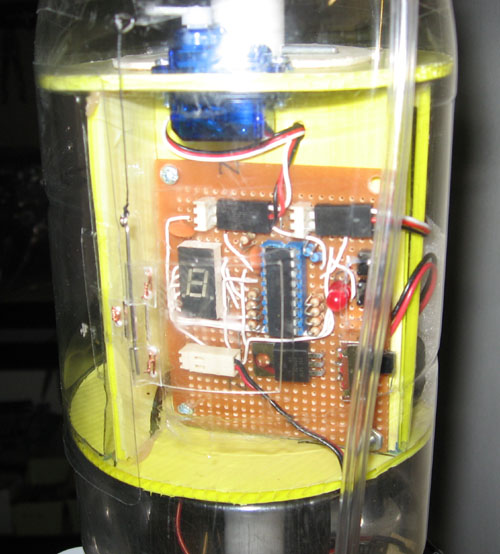
Version 1.4 of the flight computer extends the functionality of
V1.3.1. It
has been designed specifically to work with a booster in a two
stage rocket. It controls two RC servo actuators. One releases
the staging mechanism and the other to deploys the parachute.
The computer also does not use a launch detect switch, instead
it uses a pressure switch that detects when burnout has
occurred.
The flight computer is powered by a 9V battery that is
stepped down to 6V. This allows the power supply to be replaced
by a lighter 6V battery when needed.
To date V1.4 has flown 5 times. (updated 29th March
2008 - includes day 57)
Operation
Initially when the computer is turned on, it sets the two
servos to their default closed positions.
The user then can select the length of a delay that will be
used to delay the parachute deployment after staging has
occurred. This delay allows the booster to wait until the second
stage has had enough time to clear away from the booster, and
the booster has had enough time to slow down near apogee so that
parachute deployment is less violent.
The minimum time that can be set after staging is 2 seconds,
that's because the staging servo is sent pulses for 2 seconds
for it to operate. Pressing the "Program" button repeatedly
cycles through the time delay values.
The allowed delays can be set in quarter second increments as
follows:
| LED Display |
Deploy Delay after staging
(Seconds) |
| 0 |
2 |
| 1 |
2.25 |
| 2 |
2.5 |
| 3 |
2.75 |
| 4 |
3 |
| 5 |
3.25 |
| 6 |
3.5 |
| 7 |
3.75 |
| 8 |
4 |
| 9 |
4.25 |
| A |
4.5 |
| b |
4.75 |
| C |
5 |
| d |
5.25 |
| E |
5.5 |
| F |
5.75 |
| G |
6 |
| h |
6.25 |
| i |
6.5 |
| J |
6.75 |
| k |
7 |
| L |
7.25 |
| m |
7.5 |
| n |
7.75 |
| o |
8 |
| P |
8.25 |
| q |
8.5 |
| r |
8.75 |
| S |
9 |
| t |
9.25 |
| U |
9.5 |
| v |
9.75 |
| w |
10 |
After the delay is set the the rocket needs to be pressurised
in order for the pressure switch to deactivate. Once sufficient
pressure has been supplied to the rocket. The system can be
armed by pressing the "Arm" button.
The FC now waits until the pressure switch activates. When
burn-out is detected a quarter of a second later the staging
servo activates to release the second stage.
The FC then waits the chosen delay and activates the
parachute deploy servo. After the parachute has been deployed
the FC returns both servos to their default positions. Software
The assembly source code can be found here:
Flight1_4.asm
The assembled HEX code can be found here:
Flight1_4.HEX |